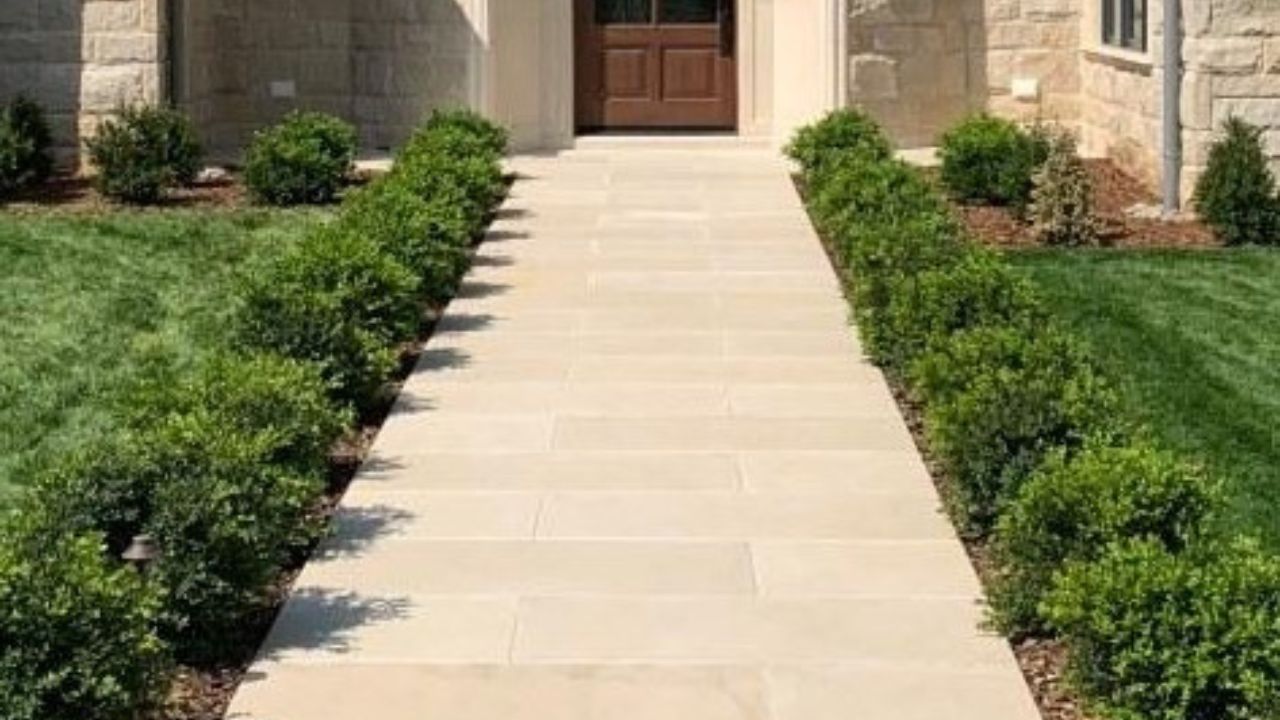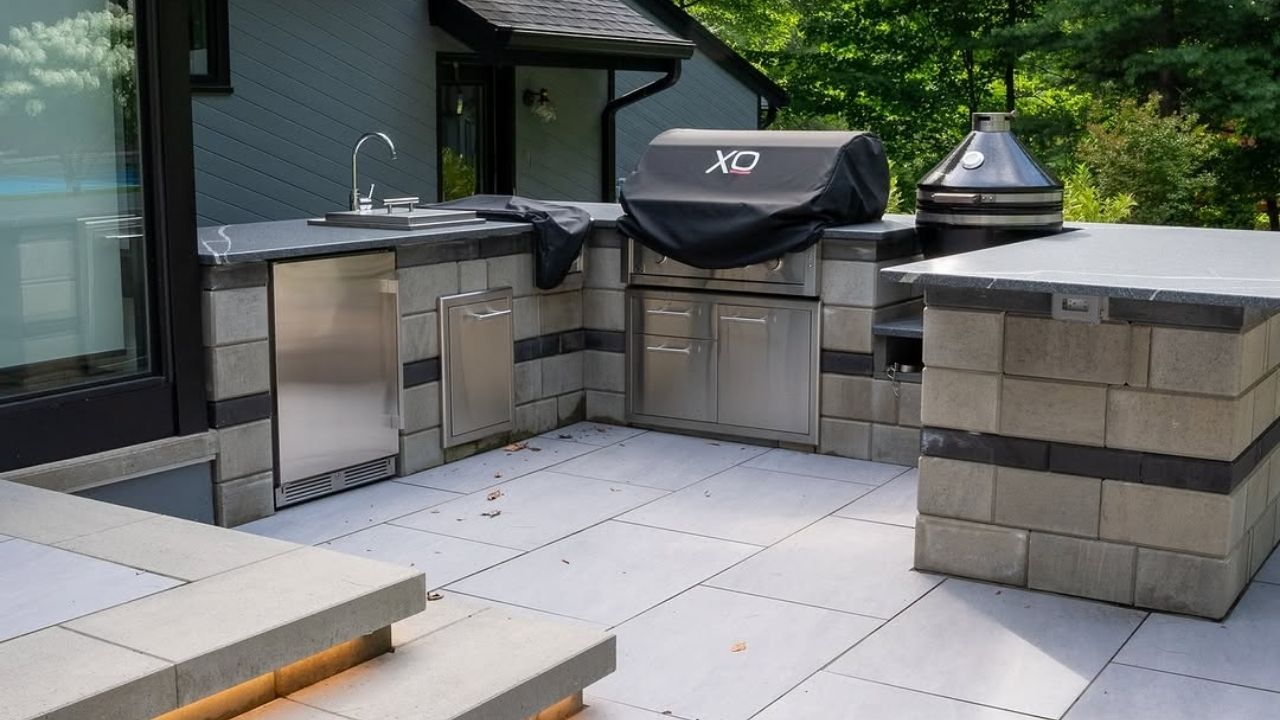
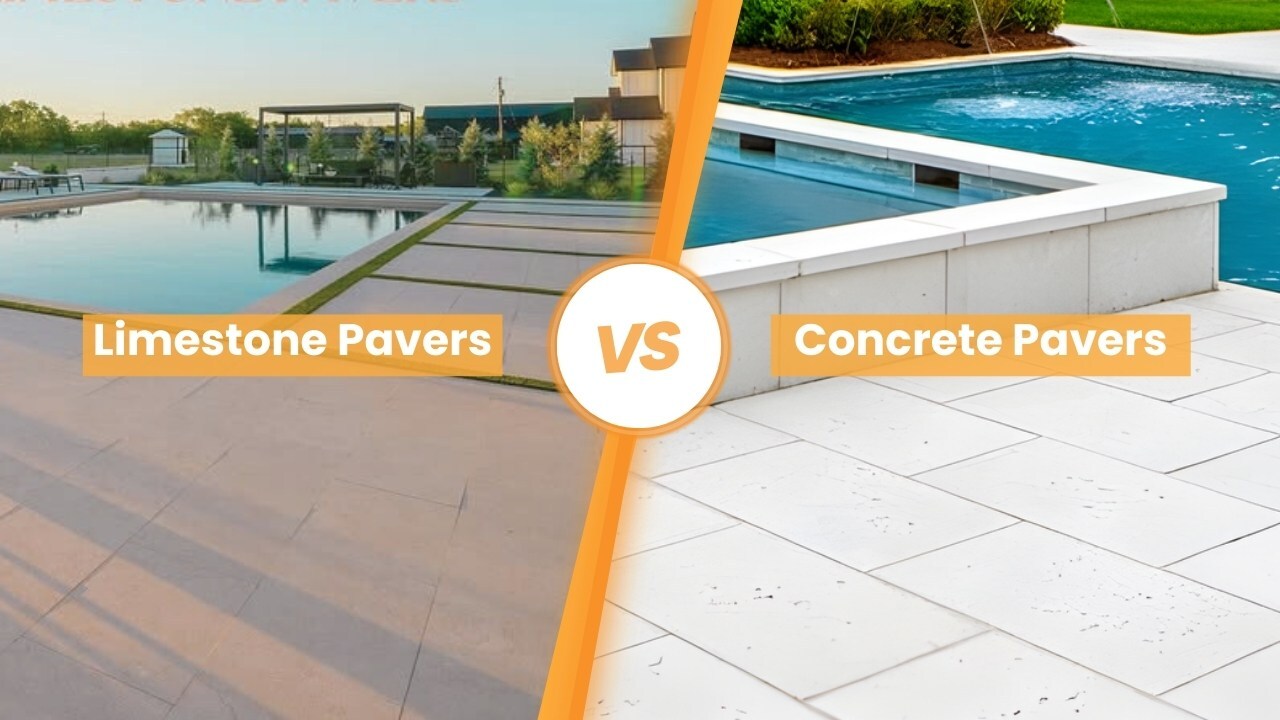
Homeowners these days have more outdoor design choices than ever before. From patios, pool decks, to walkways and driveways no longer act as a functional role. They help you design the look and feel of your property and value. However, among the range of materials, two dominant materials are limestone pavers and concrete pavers. Both are used for residential landscapes, offer durability, and claim versatility. Yet they behave very differently once installed. Is limestone paver better than concrete? What should be your consideration for your property? Continue reading the following to learn about both of these pavers so you can make an informed decision.
Limestone Pavers vs Concrete Pavers: Core Comparison Table
Both limestone and concrete pavers are widely used for landscaping projects and residential projects. One is organic, while the other is manufactured. Take a look at the following table to understand the core difference between limestone pavers and concrete pavers.
| Feature | Limestone Pavers | Concrete Pavers |
| Material origin | Natural sedimentary stone | Manufactured cement-based product |
| Color stability | Maintains color over time | Color fades with UV exposure |
| Surface temperature | Stays cooler underfoot | Absorbs and retains heat |
| Durability | High when properly installed | Moderate to high, varies by mix |
| Water absorption | Low to moderate | Moderate |
| Slip resistance | Naturally textured | Depends on the finish |
| Maintenance needs | Periodic sealing | Frequent cleaning, resealing |
| Repair approach | Individual stone replacement | Individual paver replacement |
| Typical cost (installed) | Higher upfront | Lower upfront |
| Visual character | Organic variation | Uniform appearance |
What Are Limestone Pavers?
Limestone pavers take shape over millions of years through compacted marine sediments. This process results in a thick and breathable stone with subtle fossil patterns and mineral variation. Homeowners prefer limestone due to its authentic, organic, and natural charm. The surface stays cool, and the aging process is graceful naturally. A unique feature is limetsone pavers is their look, which becomes even more attractive as it starts to wear.
At NT Pavers, limestone often appeals to homeowners who value long-term character over short-term polish.

What Are Concrete Pavers?
Concrete pavers use a mix of cement, sand, aggregate,e and pigments. Manufacturers use molds to create consistent shapes. This process results in a predictable size and pattern.
Concrete pavers are the ideal choice for homeowners with a limited budget who prefer design flexibility. Concrete comes in a wide range of shapes, from rectangles to complex interlocks. Concrete works great when manufacturers control curing and compaction. It also comes in different qualities depending on plant, mix ratio, and reinforcement methods. This variation explains why concrete pavers age differently across projects.
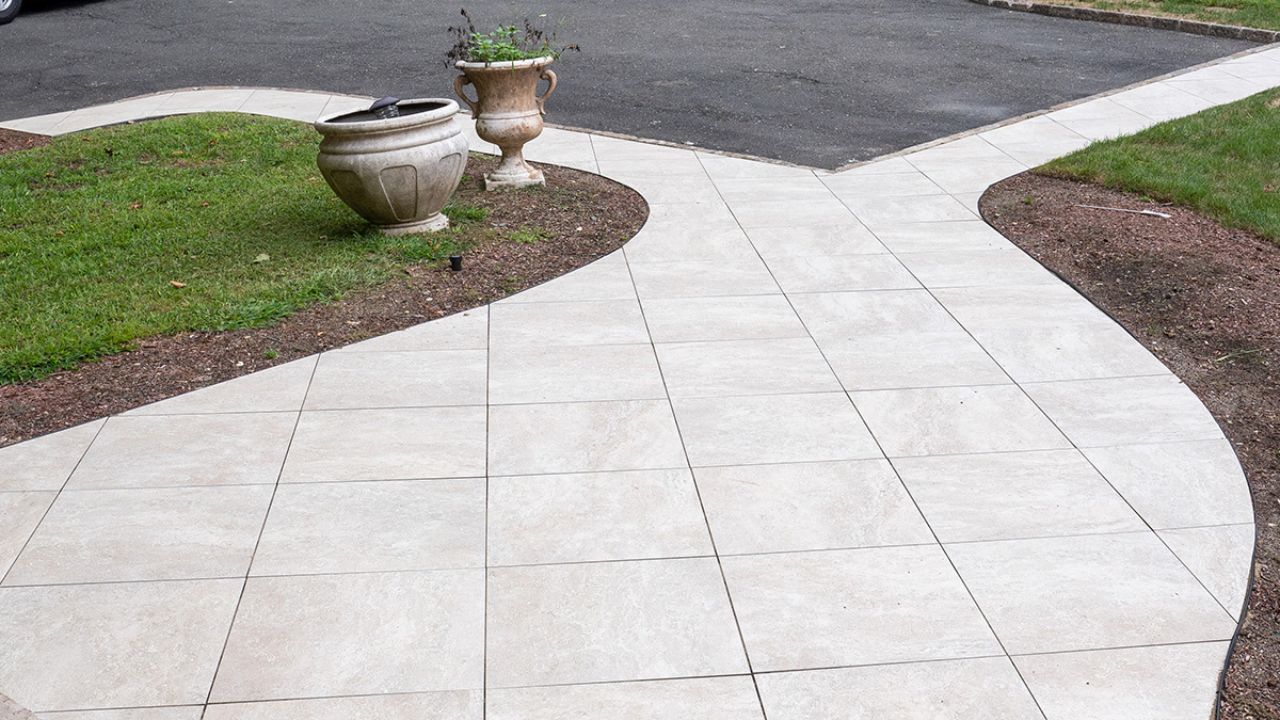
How Do Limestone And Concrete Pavers Installation & Structural Performance Compare?
When it comes to limestone vs concrete pavers, installation makes a huge difference. They both have distinct installation methods and requirements.
| Installation Factor | Limestone Pavers | Concrete Pavers |
| Recommended Base | Compacted crushed stone + bedding layer | Compacted crushed stone + bedding layer |
| Thickness Options | 1¼”, 1½”, 2″ (commonly thicker) | 1¾”, 2⅜” |
| Load-Bearing Capacity | High with proper thickness | High due to engineered density |
| Edge Restraint Sensitivity | Moderate | High |
| Cutting & Shaping | Requires a stone saw and skilled labor | Easier to cut and shape |
| Installation Skill Level | Medium to high | Low to medium |
| Installation Error Tolerance | Lower | Higher |
This table shows how the installation quality affects the performance more than the material itself.
Limestone pavers’ performance heavily relies on proper thickness, a stable base, and skilled cutting to perform well for decades. When installers ignore or misjudge the slope, the limestone shows wear faster due to a lack of manufactured uniformity.
Concrete can tolerate small installation errors due to engineered consistency. However, they still require a strong edge restraint to prevent movement.
This difference shows why limestone requires precise and professional installation, while concrete installation is more flexible without immediate visual impact.
How Long Do Limestone And Concrete Last After The Warranty Ends?
Aging is a natural process. The aged look after a certain period of time between limestone pavers vs concrete pavers is drastically different.
| Performance Over Time | Limestone Pavers | Concrete Pavers |
| Year 5 | Looks largely unchanged | Minor surface wear |
| Year 10 | Develops patina | Noticeable color fading |
| Year 15 | Surface smooths naturally | Possible surface erosion |
| Year 20 | Still structurally sound | Often needs replacement |
| Repair Visibility | Low | Moderate to high |
| Aesthetic Trajectory | Improves | Declines |
Limestone, being a natural stone, ages slowly. The surface softens edges, relaxes, and the color depends on natural patina rather than damage. These changes usually improve the look of the space.
Concrete pavers age differently compared to limestone pavers. Pigments fade under direct sun exposure, and the surface may erode from freeze-thaw cycles, deicing salts, and foot traffic. Also, any repairs will be visible on the surface because any replacement rarely matches the existing one.
Aging behavior matters more than early appearance, especially for patios, pool decks, and primary outdoor living areas.
Safety and Comfort Comparison Between Limestone Pavers and Concrete Pavers
Limestone pavers vs concrete pavers is incomplete without a safety and comfort comparison. Both materials are distinctly different when it comes to a comfortable walking surface for safety.
| Safety & Comfort Factor | Limestone Pavers | Concrete Pavers |
| Barefoot Comfort | High | Moderate |
| Summer Surface Temperature | Cooler | Warmer |
| Poolside Suitability | Excellent | Good with textured finish |
| Winter Traction | Good when dry | Depends on the finish |
| Edge Softness | Naturally softened | Sharper edges |
| Child-Friendly | Yes | Yes, with a proper finish |
Safety and comfort are crucial for any outdoor activity, regardless of the scale.
Limestone pavers stay cooler when exposed to direct sun. This is especially useful for areas around swimming pools, patios, and barefoot traffic zones. They have a naturally textured surface that improves slip resistance without excessive finishes. This makes limestone a common choice for residential pool decks and family courtyards.
Concrete pavers, on the other hand, perform safely, but they require surface treatment along with color choice and edge profile. Dark concrete absorbs more heat, and sharper edges are less flexible in play areas.
Limestone Pavers vs Concrete Pavers: The Maintenance Difference
Maintenance requirements determine how the material will act in the long run. Both materials have unique maintenance requirements.
| Maintenance Task | Limestone Pavers | Concrete Pavers |
| Sealing Frequency | Every 2–4 years | Every 2–3 years |
| Cleaning Method | Mild soap, water | Pressure wash acceptable |
| Stain Resistance | Moderate when sealed | Moderate |
| Efflorescence Risk | Low | Moderate to high |
| Moss/Algae Growth | Low | Moderate |
| Long-Term Effort | Predictable | Gradually increases |
Limestone pavers require scheduled sealing depending on the area and usage throughout the year. With proper limestone cleaning and sealing, the surface resists staining and significantly reduces algae growth, even in shaded or poolside areas.
Concrete pavers may feel easy to maintain at first, as pressure washing can restore their appearance. But the surface starts to wear over time. Also, the wear increases porosity, which also results in efflorescence, color loss, and organic growth.
These problems will raise the cleaning frequency and sealing requirements. Homeowners who prefer long-term use will need to focus on regular maintenance rather than the increased maintenance over time.

Lifecycle Cost Comparison Between Limestone Pavers vs Concrete Pavers
The overall lifecycle cost between limestone and concrete pavers is much different, where one may cost less at the start, but the expenses will gradually be more due to maintenance, repairs, or replacements.
| Cost Factor | Limestone Pavers | Concrete Pavers |
| Initial Material Cost | Higher | Lower |
| Installation Cost | Higher | Lower |
| Maintenance Cost (20 yrs) | Moderate | Moderate to high |
| Replacement Likelihood | Low | High |
| Total 25-Year Cost | Comparable or lower | Often higher |
| ROI on Resale | Higher | Neutral |
Limestone is an ideal choice for homeowners who prefer a material for long-term maintenance rather than just an initial lower cost. Limestone pavers cost more at installation, but their durability reduces replacement expenses over decades. Even the maintenance remains consistent throughout the decades.
Concrete pavers have a lower initial cost, but surface wear, fading, and higher replacement costs will result in long-term costs. Concrete can be more expensive over a 20-25 year period due to maintenance and replacement compared to limestone pavers.
Also, natural stone hardscaping can be helpful in good resale pricing if you have plans to sell it to potential buyers. Limestone is associated with permanence, craftsmanship, and long-term outdoor performance.
How Design Compatibility Differentiates Limestone And Concrete Pavers?
Design compatibility affects how cohesive an outdoor space feels with the home itself. Limestone offers better design flexibility compared to concrete. Take a look at this table.
| Design Style | Limestone Pavers | Concrete Pavers |
| Traditional | Excellent | Good |
| Mediterranean | Excellent | Fair |
| Modern Minimalist | Good | Excellent |
| Rustic / Natural | Excellent | Poor |
| Transitional | Excellent | Good |
| Luxury Outdoor Living | Preferred | Secondary |
Limestone pavers offer natural variation, soft edges, and mineral depth. It aligns well with traditional, Mediterranean, and rustic architecture. These styles take advantage of materials that feel warm and architectural.
Concrete pavers suit modern and minimalist designs where clean lines, uniform color, and sharp geometry matter more than texture. Limestone bridges indoor and outdoor design more perfectly in transitional or luxury outdoor living spaces.
Homeowners who prioritize visual continuity often choose materials based on architectural harmony rather than performance alone.
Best Use Cases: Limestone Pavers vs Concrete Pavers
Limestone pavers perform best when comfort, surface temperature, and appearance matter. Concrete pavers perform better where structure, load capacity, and budget predictability are preferred.
| Limestone Pavers | Concrete Pavers |
| Pool decks where cooler surfaces improve barefoot comfort | Driveways that carry regular vehicle weight |
| Patios designed for long seating, dining, and gathering | Utility walkways with frequent use |
| Courtyards that prioritize appearance and natural texture | Rental properties needing cost control |
| Garden paths that blend with landscaping | Large projects are built in phases |
| Outdoor kitchens with foot traffic, not heavy equipment | Areas where uniform shape and pattern matter |
| Spaces near water where natural grip improves safety | Installations requiring engineered load ratings |
| High-visibility areas that act as a design focal point | Projects with tight upfront budgets |
Limestone vs Concrete Pavers FAQs
Let’s answer your questions about limestone pavers vs concrete pavers.
Are limestone pavers slippery when wet?
No. Natural limestone offers a texture that improves traction, especially in honed and lightly textured finishes.
Do concrete pavers crack easily?
No. Concrete resists cracking but can chip, spall, or fade over time, especially in freeze–thaw climates.
Can limestone pavers handle driveways?
Yes. When thick and dense limestone is installed over a proper base.
Which paver stays cooler around pools?
Limestone stays cooler than concrete due to its lighter color and natural porosity.
Do limestone pavers need sealing?
Yes. Just like most natural stone pavers, sealing protects against moisture and staining.
Which option offers better long-term value?
Limestone usually offers long-term value due to its durable look and surface with lower replacement needs.
Bottom Line
Limestone pavers and concrete pavers both offer their distinct performance. The right choice depends on how you will use the space, your plan to use the space, and your maintenance preference.
Limestone works best where homeowners value comfort, appearance, and long-term performance. Concrete pavers are well-suited for budget-friendly and uniformity matters more.
At NT Pavers, material selection focuses on fit, not trends. As a trusted Limestone pavers supplier in Maclean, Virginia, that mindset helps homeowners build outdoor spaces that last.